
SOLAR RECYCLING REALITY- Millions of Old Panels are Being Replaced. Where Does this Hazardous Waste Go?
A market survey of U.S. solar panel recycling — the practices, the pathways, the documented externalities, and the certified domestic alternative.
THESIS
Big Solar is repowering.
The U.S. faces approximately one million tons of decommissioned solar panels by 2030 and roughly ten million tons by 2050[1], [2]. Many of those panels meet RCRA hazardous-waste criteria for toxicity[3]. We surveyed the U.S. and global recycling landscape to find out what is actually happening to these panels.
Start with the root problem. The default domestic fate of an end-of-life panel is the landfill — or open-yard storage that drifts toward it. Because many modules meet RCRA toxicity criteria, federal and state regulators classify discarded panels as hazardous or universal waste precisely because their lead, cadmium, and other constituents can leach; the Toxicity Characteristic Leaching Procedure that governs their disposal is designed to simulate the conditions inside a municipal landfill[4]. California became the first state to move discarded modules into its universal-waste program for exactly this reason, and the broader regulatory apparatus exists to keep these materials out of landfills[5]. Landfilling is the failure the entire regime is built to prevent, and it is the point on which the industry already agrees. And it is the norm, not the exception: EPA estimates that only about 10 percent of end-of-life U.S. solar panels are recycled, which means roughly 90 percent are landfilled — whole, intact, and by default — because dumping a panel costs a few dollars while recovering one costs ten to thirty times more[6]. The question this survey asks is what happens after a panel is diverted from the landfill. The dominant U.S. answer is not responsible recycling but shred-and-export to an offshore smelter — a pathway that does not close the loop so much as relocate the harm, externalizing the environmental burden rather than eliminating it. “Recycled” is not a synonym for “responsibly handled.” The responsible answer — reuse and resale of still-serviceable modules first, the highest-value and most overlooked pathway, then certified, zero-landfill domestic recovery with full chain-of-custody — exists, but at a single operating facility.
The finding is direct. Almost none of what the United States calls “solar recycling” is closed-loop recovery. Three practices dominate instead — landfilling, offshoring, and camouflaging (disposal disguised as recycling) — and all three are the same failure in different clothing: the material never becomes clean feedstock again, and a customer, an investor, or a regulator usually cannot tell any of them apart from the real thing. The certified, closed-loop domestic alternative exists and operates at industrial scale, but at a single facility. The next six months decide which model defines the U.S. solar end-of-life industry.
METHODOLOGY
Scope: this survey concerns grid-scale photovoltaic modules — the crystalline-silicon and cadmium-telluride panels used in utility, commercial, and residential electricity generation — not the small consumer panels found in chargers, garden lights, toys, and hobby products. This survey draws on (a) U.S. and Korean regulatory disclosures (U.S. EPA settlements and rules; California DTSC; Texas Commission on Environmental Quality; Korean Ministry of Environment administrative actions); (b) peer-reviewed scientific literature on smelter-area heavy-metal contamination and human exposure; (c) certification body records (SERI); (d) the IEA PVPS Task 12 third update Life Cycle Inventory dataset (April 2026)[7]; (e) corporate public disclosures by the named operators; and (f) trade-press reporting, in each case verified against the underlying primary sources in categories (a)–(e) above.
SEVEN FINDINGS
What the survey found.
01. The U.S. shut down domestic primary smelting because it could not be done cleanly.
Recovering the metals in a solar panel — silver, copper, lead, and, in thin-film modules, cadmium and tellurium — ultimately requires smelting, and the United States no longer performs that step domestically. The Doe Run Herculaneum facility in Missouri — the last operating primary lead smelter in the United States — closed on December 31, 2013[8]. The closure was the direct consequence of the EPA’s 2008 tightening of the National Ambient Air Quality Standard for lead from 1.5 µg/m³ to 0.15 µg/m³ under the Clean Air Act, a tenfold reduction[9]. EPA’s 2010 settlement made continued primary smelting unviable under the new standard[10]. The U.S. did not ban lead smelting. It set a public-health air-quality standard so stringent that primary smelting could not survive under it. There is no operating U.S. facility today that refines primary heavy metals — lead, cadmium, tellurium, selenium — from solar panel residues at industrial scale. Any operator claiming full recovery of those metals from end-of-life solar panels is, by physical necessity, sending the material somewhere outside U.S. jurisdiction for the final step. That constraint applies specifically to primary smelting of those metals, not to domestic recovery as such: the certified pathway described in Finding 7 recovers commodity-grade aluminum, glass, silicon, and silver- and copper-bearing concentrates that re-enter U.S. supply chains through existing domestic refiners and markets, without primary lead smelting. The U.S. shut down this pathway domestically because of its documented community-health and air-quality impacts. The dominant U.S. solar recycling stream now sends its material directly to that pathway abroad.
02. A vertically integrated foreign smelter has built the dominant U.S. solar-end-of-life pathway.
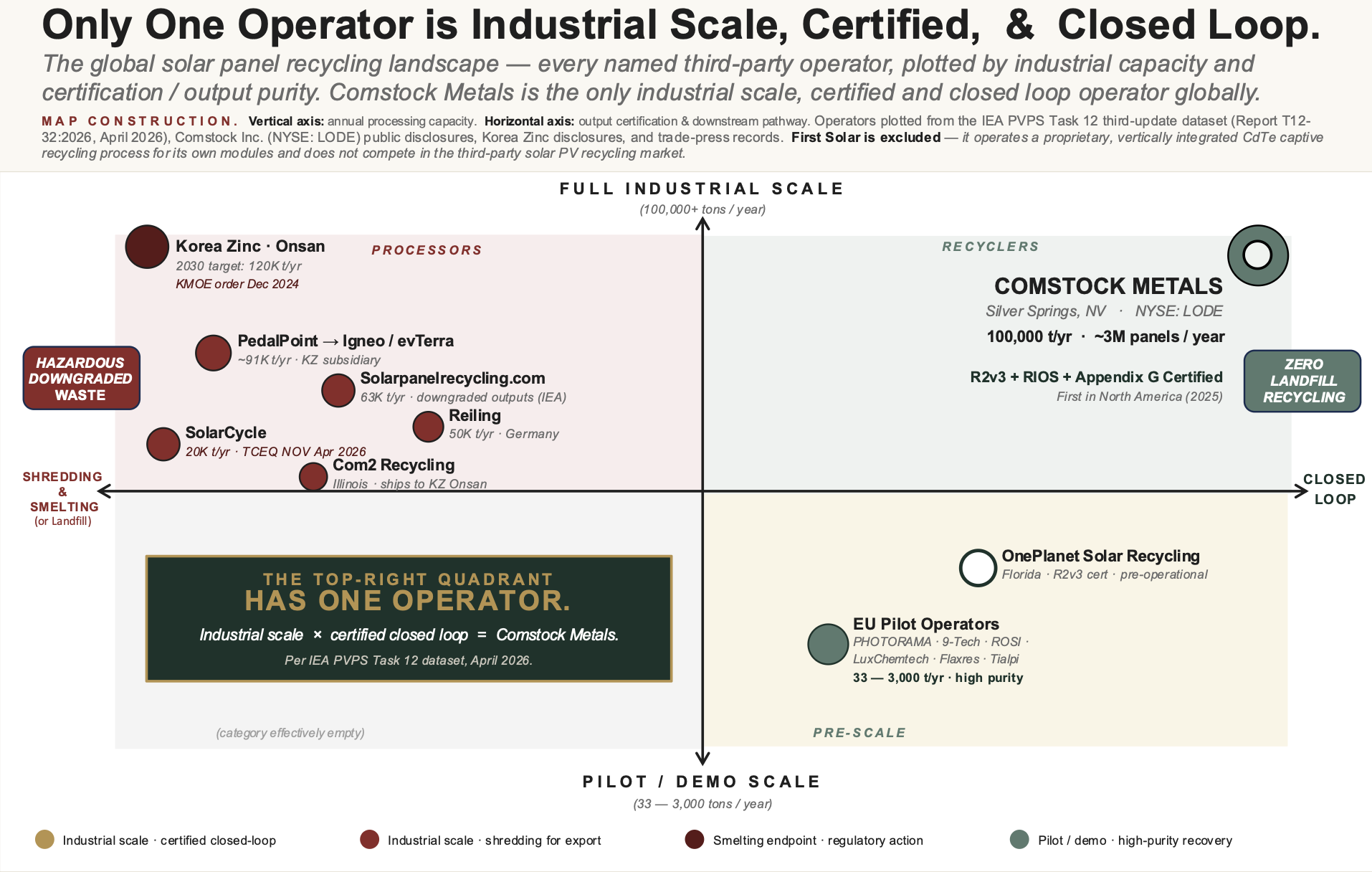
Korea Zinc, the South Korean smelting major (KRX-listed; 2024 production capacity 650,000 t/yr zinc and 420,000 t/yr lead at Onsan)[11], majority-owns PedalPoint Holdings — its U.S. circular-resources subsidiary established in 2022 — which in turn owns Igneo Holdings (parent of Igneo Technologies, Igneo France, and evTerra Recycling)[12]. evTerra operates four U.S. shredding facilities (Atlanta, GA; Elgin, IL; San Antonio, TX; Henderson, NV) with combined capacity of over 200 million pounds of e-scrap per year[13]. SolarCycle, a separately owned operator with facilities in Texas, Arizona, and a planned Georgia expansion, has publicly stated that recovered metals from its U.S. processing flow to Korea Zinc for downstream smelting and refining[14]. PedalPoint has publicly stated that aluminum frames and glass are separated and recovered while remaining components containing silver and copper are sent to Korea Zinc for final extraction[15]. In April 2026, Korea Zinc additionally acquired the former Nyrstar smelter site and mines in Tennessee, signaling intent to bring some smelting capacity back into U.S. jurisdiction under its own ownership[16]. The dominant flow of value from U.S.-installed solar metals currently moves through a single foreign smelting endpoint owned by a single corporate group.
03. The structural arithmetic forces overseas feedstock acquisition.
Korea Zinc’s stated 2030 target is 120,000 tons per year of solar panel processing capacity at Onsan[17]. Korean domestic solar PV waste generation, per South Korean Ministry of Trade, Industry and Energy (MOTIE) projections, is approximately 1,222 tons in 2025, rising to 2,645 tons by 2027, 6,796 tons by 2029, and 9,632 tons by 2032[18]. The arithmetic is unambiguous: meeting the 2030 target requires overseas — predominantly U.S. — feedstock acquisition at substantial volumes, well above an order of magnitude over Korean domestic supply through the end of the decade. PedalPoint’s published U.S. c-Si solar recycling rate, in the company’s own materials, is $0.20–$0.30/lb[19]. The structural pattern — a vertically integrated foreign smelter with stated capacity targets requiring overseas feedstock acquisition, operating U.S. preprocessing through wholly-owned subsidiaries — is the underlying competitive dynamic of the dominant U.S. solar end-of-life pathway. The IEA PVPS Task 12 third update (April 2026) characterizes the outputs of the dominant U.S. mechanical recyclers as “downgraded” — the IEA’s own term — relative to the high-purity recovery achievable through the certification-aligned alternative documented in Finding 7[20].
04. Shred-and-export is preprocessing for a foreign smelter, not closed-loop recycling.
Across the dominant U.S. operator set, the standard process is: (1) remove the aluminum frame, (2) shred the remaining panel — glass, encapsulant, backsheet, and cells — into mixed flake, (3) ship the mixed flake to a smelter offshore for metals extraction. The shredded output cannot re-enter a domestic supply chain as commodity-grade glass, silicon, silver, or copper because the encapsulant adhesive contaminates the glass and the cells are no longer recoverable in pure form. What cannot be sold is discarded: the encapsulant-contaminated glass and mixed fines that make up much of every shredded panel go to landfill regardless. Shredding does not divert a panel from the landfill so much as delay and disguise its arrival. The pathway recovers the aluminum frame and the value of metals smelted in Korea. It does not recover the glass, the silicon, or the U.S. critical minerals supply-chain position. Under EPA’s own framing, true recycling recovers and purifies the source materials[21]. The dominant U.S. pathway does not meet that bar; it is preprocessing for export.
The vocabulary matters. Under EPA’s definition, an operation that removes a frame and ships downgraded flake is a processor, not a recycler — and the market’s use of one word for both is precisely why buyers cannot tell the difference. By mass, the distinction is stark: the aluminum frame — roughly a tenth of a module’s weight — is the only material the dominant pathway reliably returns to commodity grade domestically[22]; the remaining roughly 90 percent — glass, polymers, silicon, silver, copper — is downgraded, exported, or landfilled. The documented exception is First Solar’s captive thin-film system, which recycles the company’s own cadmium-telluride modules at commercial scale but is closed to the broader market[23].
05. The export pathway has documented externalities at both the smelting endpoint and at U.S. preprocessing sites.
Smelting endpoint — peer-reviewed scientific literature.
Begin with the process itself. Smelting non-ferrous metals — separating a target metal from ore and concentrates at high temperature — is inherently emissions-intensive and is among the most heavily documented sources of heavy-metal and sulfur-dioxide pollution in the environmental literature. Smelter emissions are estimated to account for 40 to 73 percent of all anthropogenic heavy-metal input to the environment.[24] A data-integration study of soils around 54 lead-zinc smelters worldwide found severe contamination concentrated within two kilometers of the facilities, with arsenic, cadmium, lead, and zinc identified as priority pollutants for both ecosystem and human health.[25] Modern smelters can control these releases, but only at significant cost; where controls are weak, lapsed, or absent, the result is persistent contamination of air, soil, and water.[26] This is the same hazard profile that led the United States to allow domestic primary lead smelting to end rather than operate it under tightened air-quality standards, as Finding 1 describes. Where recovered solar material is sent, and under what regulatory regime it is processed, therefore matters.
The Korean zinc-smelting complex that receives this material is not a hypothetical externality. Peer-reviewed scientific literature documents concrete, measured impacts across the two facilities that historically make up that complex — the Onsan smelter in Ulsan, operated by Korea Zinc, and the Seokpo smelter in Bonghwa, operated by Young Poong. The two facilities are commonly assessed together as the Korean zinc-smelting complex. The measured record:
· In the Onsan industrial complex in Ulsan — the multi-smelter hub that includes Korea Zinc’s Onsan smelter, the publicly stated destination for SolarCycle’s recovered metals — stream sediments contain heavy-metal concentrations 3 to 1,302 times higher than in urban and other industrial areas of South Korea, statistically attributed to the complex’s smelting facilities[27].
· Road-deposited sediments around the same Onsan complex carry potentially toxic element concentrations among the highest reported for comparable sediments anywhere in the world[28].
· At the Seokpo zinc smelter in Bonghwa, operated by Young Poong, soil studies document continuous heavy-metal input from the facility, with horizontal distribution patterns matching wind direction and distance from the smelter[29].
· Residents living near the Seokpo smelter show elevated blood-lead and urinary-cadmium levels relative to control populations, after controlling for age, sex, smoking, and occupational exposure[30].
· In late December 2024, the Korean Ministry of Environment’s Nakdong River Basin Environmental Office issued an administrative order against Korea Zinc’s Onsan smelter under Article 27 of the Chemical Substances Control Act, barring the facility from storing sulfuric acid gas brought in from third parties; the order took effect in January 2025. The order concerns third-party chemical storage and is entangled in the Korea Zinc–Young Poong corporate-control dispute; it is not an emissions or contamination finding against the smelter’s core operations; Korea Zinc complied, and Young Poong’s attempt to compel continued handling was finally dismissed in May 2026[31].
U.S. preprocessing sites — state regulatory enforcement record.
Externalities at the U.S. preprocessing end of the pathway are also entering the public regulatory record. On April 30, 2026, the Texas Commission on Environmental Quality (TCEQ) issued a Notice of Violation against SolarCycle’s Odessa, Texas facility (Regulated Entity RN103113692; Customer CN606087070; 8000 Golder Avenue, Odessa, TX 79764, Ector County). The cited violation is failure to monitor stormwater discharges from regulated industrial activities, in violation of 30 TAC 281.25(a)(4) and Texas Pollutant Discharge Elimination System General Permit No. TXR05FZ74, Part IV Section A.1 and Part V Section N.4. The investigation (TCEQ Investigation Number 2130309) was triggered by Complaint 455069, received March 23, 2026, in which the complainant alleged improper storage of solar panels in the facility yard[32]. The complaint alleged that solar panels had accumulated in open-yard storage at the site. Modules held uncovered and exposed to weather can degrade and mobilize constituent materials in stormwater runoff — the contamination pathway the monitoring requirement exists to detect. The Notice of Violation addresses the failure to monitor that runoff; it is not a final determination of contamination. The complaint was logged as an industrial and hazardous-waste concern, but the violation TCEQ ultimately cited is a stormwater-monitoring failure under the facility’s TPDES permit — not a waste-handling or contamination finding. Per the WACI record, the investigation was conducted April 2, 2026; the violation is listed as resolved, and the complaint closed, on April 13, 2026; the formal Notice of Violation is dated April 30, 2026.
The TCEQ Notice of Violation is a finding of permit non-compliance, not a final determination on storage practices or processing volumes. It is, however, an official public record entered into the regulatory file by the state environmental agency with jurisdiction. Read alongside the Korean Ministry of Environment administrative order against the smelting endpoint, the pattern is the same on both ends of the pathway: regulatory regimes are beginning to catch up with the operational practices of the dominant export-dependent set, and the documentation is now in the public record.
These are not contested findings. They are published in peer-reviewed scientific literature, U.S. and Korean state regulatory enforcement records, and public agency complaint databases. The dominant U.S. solar recycling pathway routes its recoverable material into the Korean zinc-smelting complex — a process, and a sector, for which independent science has documented heavy-metal contamination of soils and sediments and elevated heavy-metal burdens in nearby populations — and the U.S. preprocessing side of that pathway has begun to generate a state-level regulatory record, of which the Odessa matter is one early documented example. Both ends of the pathway are visible to regulators in real time.
06. Camouflaging: disposal disguised as recycling — the hardest failure to see.
The third failure mode is the most insidious, because customers, investors, and regulators usually cannot tell it apart from genuine recycling. Federal law already draws the line. EPA distinguishes legitimate recycling from “sham recycling” — a management method used to make hazardous material look recycled in order to avoid handling it as waste. Recycling is legitimate only when the secondary material makes a useful contribution, the process yields a valuable product comparable to a genuine one, and the material is handled as a commodity rather than discarded. EPA’s own catalog of sham recycling includes placing heavy-metal-bearing material into construction products to which it contributes nothing, and making building materials for which there is no real market[33]. Those examples describe the solar-waste version of the practice precisely.
Applied to end-of-life solar, the pattern looks like recycling and functions as disposal. A panel is shredded and the mixed output is routed into low-grade fill, road base, aggregate, or landfill daily cover, or comingled into the construction-and-demolition (C&D) debris stream, which is largely managed as non-hazardous waste outside the federal controls that would otherwise track solar residue[34]. Nothing is recovered and purified into commodity glass, silicon, silver, or copper — EPA’s own bar for true recycling; the material is simply dispersed where no one is counting. Stockpiling is the same practice paused mid-step: under federal rules, secondary material that is not actually recycled — at least 75 percent by weight in a calendar year — is deemed discarded and regulated as waste[35].
The economics give it away. Legitimate recovery costs roughly $15 to $45 per panel and returns only about $3 to $12 of recovered material — a net cost per panel, not a profit; sending a panel to a landfill costs about $1 to $5[36]. An operator that offers to take panels at or near landfill prices cannot be performing full material recovery at that price; the arithmetic does not close. A below-cost “recycling” offer is not a bargain — it is a signal that the panel is being dispersed or dumped, not recovered.
And the harm is generational, not temporary. An intact laminated panel often passes the toxicity test because the glass-laminate encapsulation holds the metals in place — which is why whole panels can be landfilled as non-hazardous. In peer-reviewed leaching tests, that same encapsulation reduced lead mobility by a factor of four to nine; shredding destroys it, and lead in the crushed material was measured as high as 9.3 mg/L against a 5 mg/L regulatory limit[37]. Cadmium-telluride panels released roughly 73 percent of their cadmium over thirty days at more than three times the limit under simulated landfill conditions[38]. Dispersing shredded panels into fill, aggregate, or soil turns a contained hazard into diffuse, unrecoverable heavy-metal contamination of land and groundwater. Lead and cadmium do not degrade; the contamination is inherited by whoever uses that land next. Camouflaging is therefore not a lesser form of recycling — it can be worse than a properly lined landfill.
Because the marketing language is identical to genuine recycling, buyers, investors, and regulators cannot see the difference at the point of sale. The only reliable safeguard is documented downstream chain-of-custody through to final material disposition — proof, per shipment, of where every stream actually goes. That is what the R2v3 Appendix G standard requires, and what a genuine recycler can produce and a camouflager cannot (Finding 7).
07. Certification has caught up with this problem, but most U.S. operators have not.
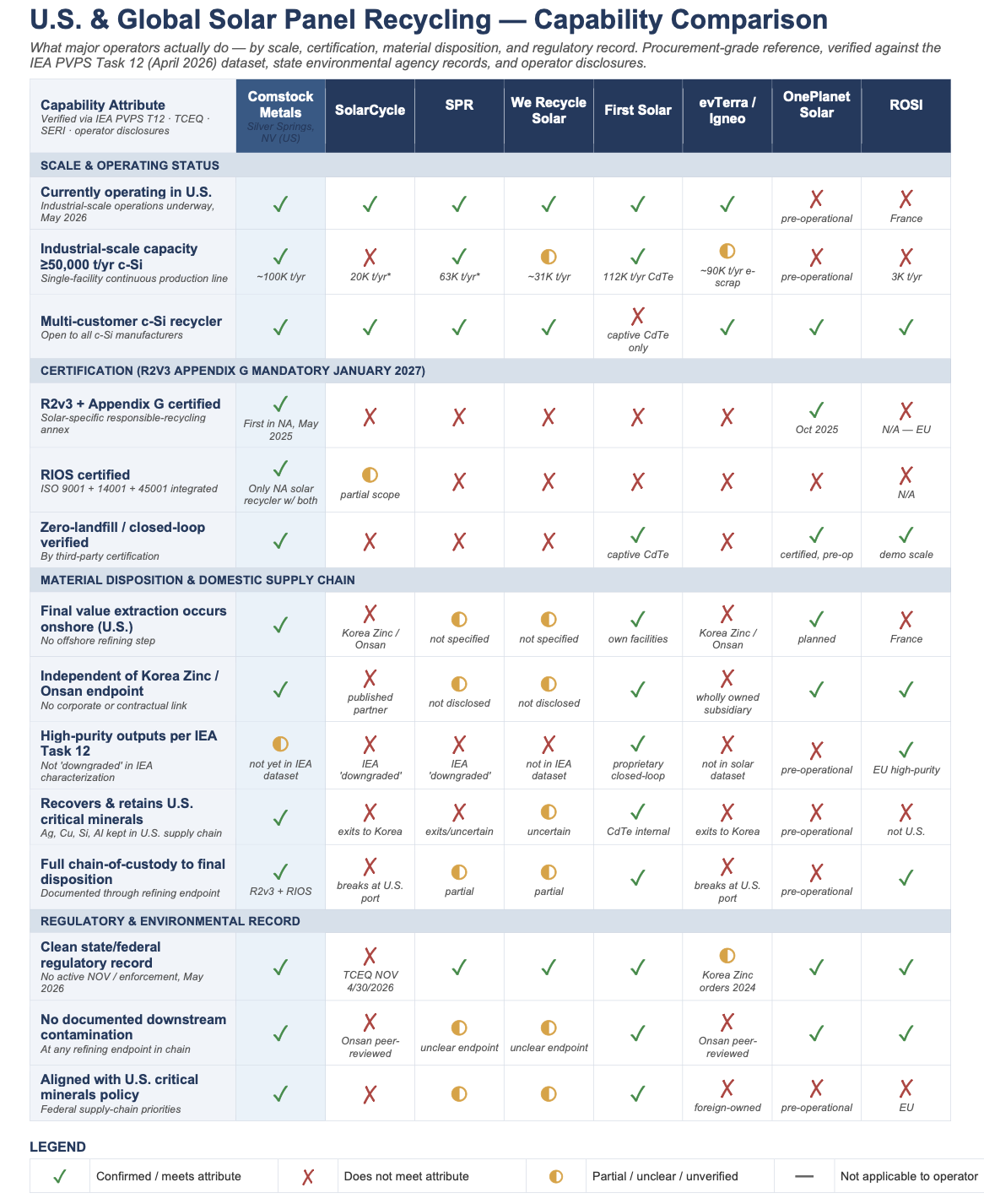
R2v3 — the responsible recycling standard administered by SERI, an ANSI-accredited nonprofit — added Appendix G, the solar panel recycling annex, on January 31, 2024. Appendix G becomes mandatory for all R2-certified solar recyclers in January 2027[39]. As of April 2026, only two North American facilities hold R2v3 + Appendix G certification: Comstock Metals in Silver Springs, Nevada[40], and OnePlanet Solar Recycling in Green Cove Springs, Florida[41] (certified, but not yet operating at industrial scale). Comstock Metals additionally holds RIOS certification — integrating ISO 9001, 14001, and 45001 — making it the only operating solar recycler in North America with both certifications and a complete downstream vendor audit[42]. The remainder of the U.S. solar recycling industry will need to achieve Appendix G compliance within the next six months or lose R2 certification status for solar work. Buyer chain-of-custody requirements compound the problem. In the shred-and-export model, panels are mechanically crushed into a mixed commodity stream and sold to an overseas smelter as blended feedstock; once the material enters commodity smelting it is no longer batch-traceable to the original end-of-life lot, and documented chain of custody to final material disposition is not maintained. The certified domestic pathway is defined by the opposite: R2v3’s downstream due-diligence and material-tracking requirements — the basis on which the certified facilities are audited — require documented custody of controlled material streams through to final disposition[43]. Asset owners relying on shred-and-export therefore cannot produce the end-to-end chain-of-custody record that defensible Scope 3 documentation requires. The TCEQ enforcement record cited in Finding 5 sharpens the procurement-side question: a buyer relying on an operator outside R2v3 + Appendix G + RIOS today may be exposed to permit-compliance risk in the supplier’s own state regulatory file, on top of the chain-of-custody and downstream emissions exposure already documented.
THE CERTIFIED DOMESTIC PATHWAY
Operating status, by facility.
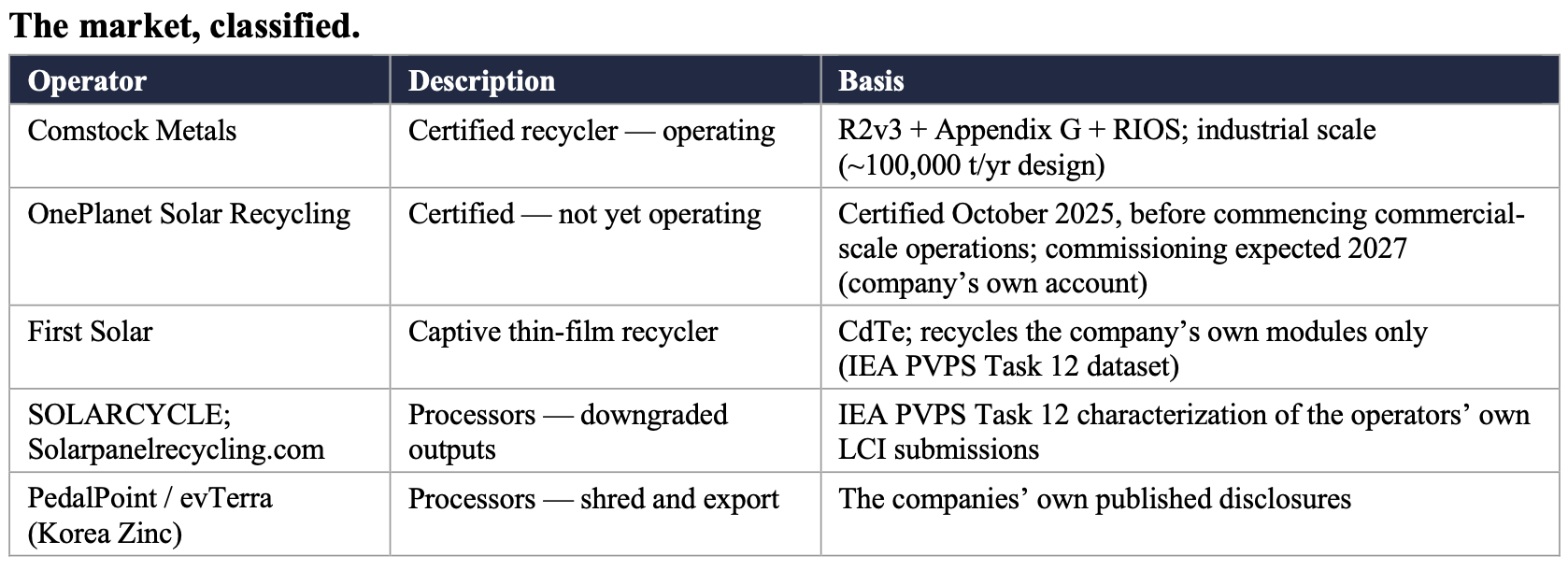
As of April 2026, two North American facilities hold R2v3 + Appendix G certification:
Comstock Metals (Silver Springs, Nevada). First R2v3 + RIOS + Appendix G certification in North America (2025). Industry-scale facility designed to process more than 3 million end-of-life solar panels per year, equivalent to up to approximately 100,000 tons of waste material annually, on a single continuous production line. All required Nevada regulatory approvals — Nevada Division of Environmental Protection Bureau of Sustainable Materials Management Written Determination Permit and Air Quality Control Permit — secured by January 5, 2026. Major precision equipment delivered Q4 2025; commissioning conducted Q1 2026 through April; continuous operations during Q2 2026. A second integrated industry-scale facility in Clark County, Nevada has its first major operating permit application submitted. A California satellite collection-and-aggregation site is operational[44] [44a].
OnePlanet Solar Recycling (Green Cove Springs, Florida). Was certified to R2v3 Appendix G in October 2025 — before commencing commercial-scale operations — and is not operating at industrial scale[45]. By the company’s own account it runs a first-stage facility, with a $90 million scale-up not scheduled to break ground until 2026 and full build-out targeted for 2030[46]. A certificate is not operating capacity. From January 2027 Appendix G is mandatory, and an R2-certified facility must then demonstrate the certified process in operation — documented chain-of-custody through to final material disposition, with annual downstream audits — not merely hold the certificate.
The structural fact: as of the publication date of this report, exactly one R2v3 + Appendix G + RIOS certified, zero-landfill solar panel recycling facility is operating at industrial scale in North America. The certified domestic alternative to the export pathway exists. It is a narrow alternative today. The six-month window between this report’s publication and the January 2027 mandatory Appendix G deadline is when that alternative either scales to meet the volume — or does not, and the export pathway becomes the locked-in industry default by inertia.
Sources: SERI records; IEA PVPS Task 12 (T12-32:2026); & operators’ own public disclosures, as cited in Findings 02–07.
TRIPLE BOTTOM LINE
What is actually being externalized.
The dominant U.S. shred-and-export pathway externalizes its costs across three dimensions:
Environmental. Approximately 5,500 nautical miles of ocean freight per ton of material from West Coast ports to South Korea[47]; smelter air-quality and slag impacts managed under Korean Ministry of Environment regulation rather than U.S. EPA standards; landfill diversion only partial because encapsulant-contaminated glass is not recovered to commodity grade; documented soil, sediment, and atmospheric heavy-metal contamination in the smelting-host region[48][49][50]; documented stormwater monitoring non-compliance at U.S. preprocessing sites[51].
Social. U.S. value-chain jobs limited to the pre-processing step; refining, value capture, and final commodity sale occur abroad; documented elevated blood-lead and urinary-cadmium levels in human populations near the Seokpo zinc smelter operated by Young Poong, part of the Korean zinc-smelting complex that receives the exported material[52]; smelting-community health burden borne by populations in Korea.
Economic. U.S.-installed silver, copper, aluminum, and silicon — each on the federal 2025 List of Critical Minerals, with silver, copper, and silicon added to that List in November 2025 — exit U.S. jurisdiction permanently in the shredded export stream; the recoverable metals return as Korean-refined commodity, not U.S. critical-minerals supply, while the silicon is not recovered at all — it is lost in the mixed shredded stream of metals and polymers at the base-metal smelter; buyer ESG defensibility limited; alignment with federal critical-minerals priorities is structurally absent from the dominant pathway[53].
The certified domestic pathway internalizes those costs inside a U.S.-permitted, third-party-audited closed loop. Recovered streams enter U.S. supply chains directly. No ocean transit. No offshore smelting. Full chain-of-custody documentation suitable for ESG and Scope 3 reporting.
One market dynamic explains why the cheaper pathway dominates despite this record. Asset owners — utilities and independent power producers — hold the ultimate end-of-life liability, yet they typically procure decommissioning and recycling through competitive EPC bids. Competitive bidding rewards the lowest-cost disposal route, and the lowest-cost route is structurally the least-compliant one. The market is selecting for the cheapest pathway, not the responsible one, while the liability for that selection stays with the asset owner. Asset owners are sophisticated buyers; the bid structures that produce this outcome are their own. The remedy is to make certification and documented chain-of-custody a procurement specification rather than a preference — the subject of the recommendations that follow.
RECOMMENDATIONS
What this calls for.
For utility, IPP, and EPC procurement teams:
Add R2v3 Appendix G certification as a mandatory procurement specification for any solar panel disposal contract. The January 2027 mandatory deadline is a forcing function.
Treat any recycling bid priced at or near landfill-disposal cost as a red flag for sham recycling, and require certificates of final material disposition, per shipment, showing where each output stream actually goes.
Require documented chain-of-custody from collection through final material disposition, not only through pre-processing.
Audit current solar end-of-life suppliers against the certified domestic alternatives. Two facilities in North America currently hold the certification. Plan accordingly.
Pull the supplier’s state regulatory file before contract renewal. State environmental agencies maintain public complaint and enforcement databases[54]. A clean record should be a baseline diligence requirement.
Reference the IEA PVPS Task 12 system boundary directly in procurement specifications for output purity tier. The IEA’s documented framework — including the IEA’s own characterization of mechanical commercial outputs as “downgraded” — is procurement-grade evidence cited by integrated resource planners and ESG analysts in their internal frameworks[55]. Operators with public claims in higher-purity categories who are not yet in the IEA Task 12 dataset have not been independently validated by the IEA’s methodology; LCI data submission per the standard Task 12 questionnaire is reasonable to require as a contract-execution condition.
For state and federal regulators:
Examine the categorization of shred-and-export pathways under existing hazardous waste export rules. California DTSC’s universal waste rule for PV modules (effective January 1, 2021) is the early signal[56]. The federal frame — RCRA implementation under the Office of Resource Conservation and Recovery — is not yet aligned with the documented externalities.
Examine whether the structural absence of U.S. primary smelting capacity for solar-relevant metals constitutes a critical minerals security exposure. Foreign-owned vertical integration of the dominant solar end-of-life pathway is the operative form of that exposure. Federal policy now treats foreign processing dependence as a national-security vulnerability in its own right: a March 2025 executive order directs the United States to become the leading producer and processor of critical minerals, and a January 2026 Section 232 action targets reliance on foreign processing of critical minerals and their derivative products. Shred-and-export routes recoverable domestic critical-mineral content to an overseas smelter for final processing — the precise dependence those measures are intended to reduce[57].
Examine the vertical integration of the dominant export pathway under existing competitive and supply-chain frameworks.
For institutional investors and ESG analysts:
When evaluating utility, IPP, and EPC issuers with significant aging solar fleets, request specific disclosure of end-of-life recycling partner identity and certification status.
When evaluating solar recycling sector pure-plays, distinguish between certified domestic recovery operators (currently one operating at industrial scale) and pre-processors dependent on offshore smelting.
Treat Scope 3 documentation defensibility, supplier-side state regulatory exposure, the IEA PVPS Task 12 dataset’s classification of operator output tier[58], and the January 2027 Appendix G deadline[59] as related material risk factors for solar fleet retirement programs.
CONCLUSION
The U.S. solar industry has spent fifteen years building one of the largest renewable energy fleets in the world. As that fleet enters its first repowering cycle, where the panels actually go is becoming a structural question — for emissions, for community health, for critical minerals, for buyer documentation, and for U.S. industrial policy. The current default answers are three — the landfill; a foreign smelter that the United States itself shut down domestically because it could not be done cleanly; or a shredder that disperses the panel into fill and soil at home under the label of “recycling.” For an industry founded on environmental preservation, the irony is difficult to overstate. The certified domestic alternative exists at operating scale today, but it is a single facility operating at industrial scale (two facilities hold the certification; one operates at scale). The interval between the publication of this report and the January 2027 mandatory Appendix G deadline is when the structure of the U.S. solar end-of-life industry is decided. The decision is reversible only at increasing cost the longer the export pathway accrues default-procurement status. The data presented here is offered to support that decision being made deliberately rather than by inertia.
APPENDIX · METHODOLOGY NOTE
The Triple Bottom Line Comparative Impact Index uses a six-dimension scoring framework: carbon footprint of disposal pathway, hazardous metal containment, U.S. critical minerals retention, U.S. value-chain jobs, certification and audit integrity, and buyer ESG / Scope 3 defensibility. Each dimension is scored 0–100 against best practice. Scores are S3’s qualitative assessment grounded in the cited public sources. A quantitative life cycle assessment in alignment with the IEA PVPS Task 12 system boundary methodology is in scope for follow-on work.
ABOUT THIS ANALYSIS
S3 — Sustainable Source Studios is an international sustainability consultancy. This analysis is based on primary regulatory records, peer-reviewed scientific literature, certification body records, and corporate public disclosures. Footnotes are provided so that any reader can independently verify the claims made.
This analysis is provided for industry research purposes only; it is not legal, financial, or investment advice, and readers should consult their own counsel and advisors.
S3 SUSTAINABLE SOURCE STUDIOS