
The capacity-purity gap.
FIELD NOTE · GLOBAL LANDSCAPE · JULY 2026 // Reading the April 2026 IEA PVPS Task 12 third-update Life Cycle Inventory report against the U.S. solar end-of-life market.
THE FRAME
The International Energy Agency’s Photovoltaic Power Systems Programme (IEA PVPS) Task 12 published the third update to its empirical Life Cycle Inventory data on PV module recycling in April 2026 (Report IEA-PVPS T12-32:2026)[1]. The Task 12 work is co-led by Garvin Heath at the U.S. National Renewable Energy Laboratory (NREL) and Etienne Drahi at TotalEnergies; the report’s authors are Karsten Wambach (Wambach Consulting, Germany) and Cara Libby (Electric Power Research Institute, USA), with editorial review by Nanette Jones (EPRI) and Garvin Heath (NREL)[2].
The report documents primary operational LCI data from PV recycling facilities across the United States, Europe, and Asia. It is the most rigorous open-source dataset on PV recycling operations currently available, drawing on direct LCI submissions from named operators reviewed against a consistent system boundary. This Field Note reads that dataset against the U.S. solar end-of-life market specifically.
WHAT THE IEA DOCUMENTS
The 2025 dataset contains LCI submissions from five contributors directly (First Solar, PHOTORAMA, SOLARCYCLE, Solarpanelrecycling.com, 9-Tech) plus retained data from seven contributors documented in the 2024 update. Out of thirteen recyclers invited to participate in the 2025 LCI survey, four submitted data plus the PHOTORAMA project consortium[3]. Capacities range from 33 t/yr (9-Tech, pilot) to 112,000 t/yr (First Solar, six-facility global CdTe network)[4].
Operators in the IEA PVPS Task 12 dataset, by capacity and output purity tier:
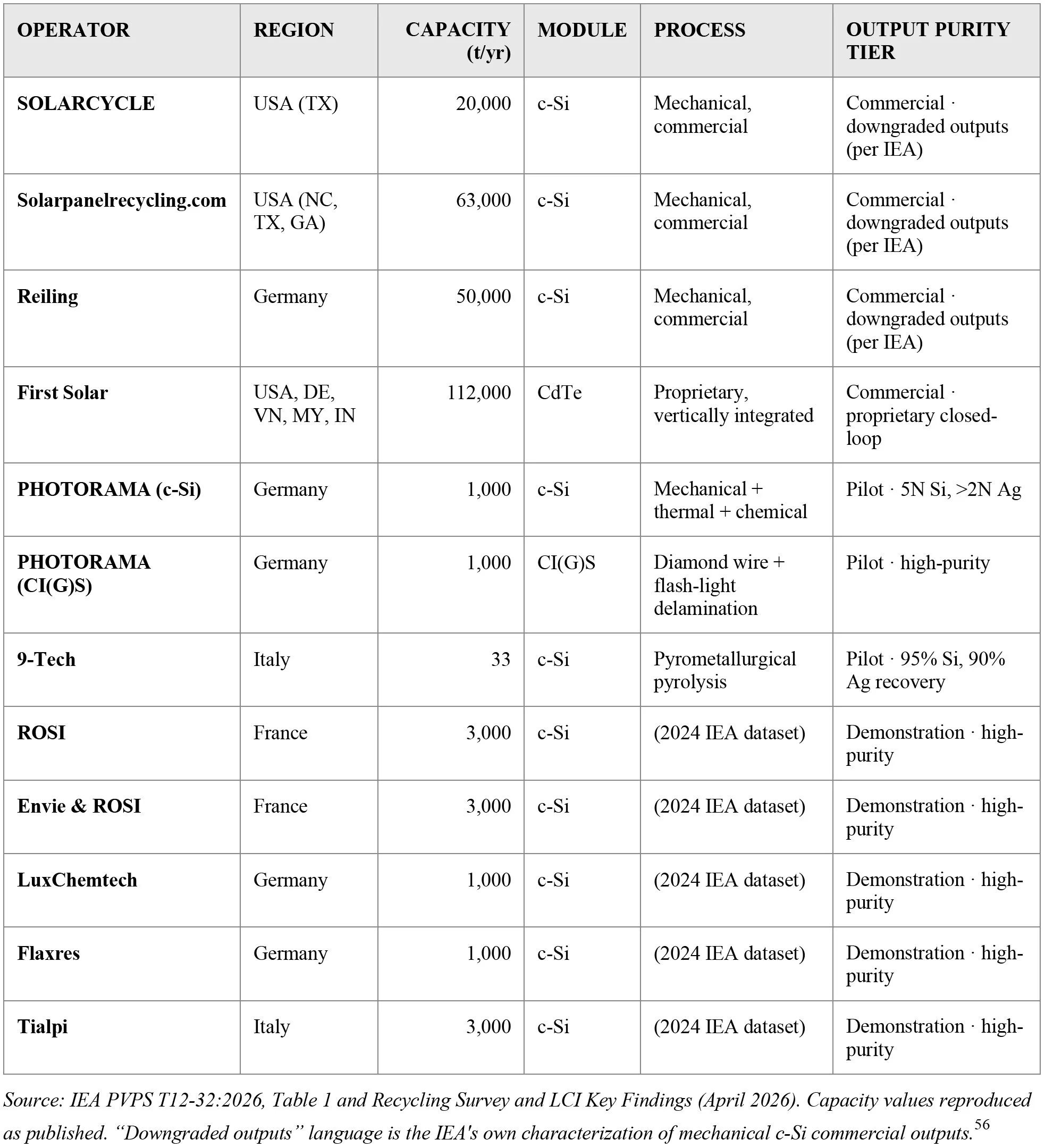
Source: IEA PVPS T12-32:2026, Table 1 and Recycling Survey and LCI Key Findings (April 2026). Capacity values reproduced as published. “Downgraded outputs” language is the IEA’s own characterization of mechanical c-Si commercial outputs.[5][6]
Aggregated by purity tier:
Commercial mechanical c-Si recycling (output downgraded per IEA): approximately 133,000 t/yr globally across three named operators — SOLARCYCLE 20,000 t/yr; Solarpanelrecycling.com 63,000 t/yr; Reiling 50,000 t/yr[7].
Pilot- and demonstration-scale high-purity c-Si recovery: approximately 12,000 t/yr globally across seven operators, primarily in EU jurisdictions, with capacity ranging from 33 t/yr (9-Tech, Italy) to 3,000 t/yr (ROSI, France; Envie/ROSI, France; Tialpi, Italy)[8].
Commercial-scale thin-film recycling: First Solar’s proprietary, vertically integrated CdTe recycling system across six facilities globally totaling approximately 112,000 t/yr — structurally distinct in that First Solar recycles its own manufactured product[9].
WHAT THE IEA SAYS ABOUT THE DOMINANT U.S. OPERATORS
The IEA’s own characterization of the SOLARCYCLE and Solarpanelrecycling.com mechanical-recycling outputs, drawn directly from the Recycling Survey and LCI Key Findings section of the report[10]:
Mechanical recycling remains the benchmark for commercial-scale silicon-based modules. SOLARCYCLE and Solarpanelrecycling.com (SPR) shared results from their mechanical-based c-Si PV recycling plants, which are optimized for cost, capacity, and output, though some outputs are downgraded.
— IEA PVPS T12-32:2026, Recycling Survey and LCI Key Findings
Two terms in this passage do the analytical work. “Mechanical recycling” — in IEA usage — describes shredding and physical separation processes. “Downgraded” — in materials engineering usage — describes outputs that cannot re-enter the same supply chain at the same quality grade as the input materials. In the c-Si context, this means recovered glass that cannot be remelted into solar glass, recovered silicon that cannot be reused at solar-grade purity (9–13N), and recovered silver that requires further refining offshore.
The IEA observation is technically neutral; the procurement-side implication is not. An asset owner specifying “PV recycling” in a contract without specifying output purity tier is, per the IEA’s documented landscape, contracting for downgraded outputs from the largest commercial-scale operators in the U.S. market.
THE CATEGORY GAP
Reading capacity tier against output purity tier across the full IEA dataset, a structural gap is visible:
Commercial scale (>20,000 t/yr) — mechanical c-Si — downgraded outputs (~133,000 t/yr global).
Pilot to demonstration scale (33–3,000 t/yr) — high-purity c-Si recovery (~12,000 t/yr global).
First Solar’s CdTe vertical (112,000 t/yr) — proprietary, captive to First Solar manufacturing.
There is no category in the IEA’s 2025 dataset for industrial-scale, high-purity, multi-customer c-Si recovery. This category is not represented anywhere in the global dataset, in any geography, by any operator that submitted LCI data[11].
WHAT IS NOT IN THE IEA DATASET
Two North American facilities hold R2v3 + Appendix G certification as of April 2026 and are not represented in the IEA PVPS T12-32:2026 dataset:
Comstock Metals (Silver Springs, Nevada). Per Comstock Inc. (NYSE: LODE) public disclosures, the facility holds the first R2v3 + RIOS + Appendix G certification in North America (2025); operational capacity of approximately 100,000 t/yr c-Si on a single continuous production line; commissioning conducted Q1 2026 through April; continuous operations during Q2 2026; published technical claims include closed-loop, zero-landfill recovery[12]. The facility was not represented in the IEA’s 2025 LCI survey window.
OnePlanet Solar Recycling (Green Cove Springs, Florida). Received R2v3 Appendix G certification in October 2025. Expected commissioning by 2027. Not yet operational at scale[13].
If Comstock Metals’s published technical claims are validated through the same LCI methodology the IEA applied to the operators in its 2025 dataset, the facility would represent a category that — per the IEA’s own data — does not currently exist in the global PV recycling industry at commercial scale: industrial-scale, high-purity, multi-customer c-Si recovery in a U.S. jurisdiction. That validation has not yet occurred. It should be the next required step.
IMPLICATIONS FOR PROCUREMENT
The IEA PVPS Task 12 report is the most rigorous open-source procurement-grade evidence currently available on the global PV recycling industry[14]. For utility, IPP, and EPC procurement teams considering solar end-of-life contracts in 2026:
The IEA’s own characterization of mechanical commercial outputs as “downgraded” is contract-specification language[15]. Procurement specifications can require output purity tier directly, by reference to the IEA Task 12 system boundary.
The capacity gap between commercial-mechanical and pilot-high-purity is a documented structural feature of the global industry as of early 2026. Procurement decisions made in this window are made into a known supply constraint.
Operators with public claims in the industrial-scale high-purity category that are not in the IEA Task 12 dataset have not yet been independently validated by the IEA’s methodology. Procurement diligence should include LCI data submission as a contract-execution requirement, on the IEA Task 12 questionnaire format if available.
RECOMMENDED NEXT STEP · IEA PVPS TASK 12 PARTICIPATION
The IEA’s Task 12 next update is the natural venue for closing the gap in the global dataset. Operators with published claims in the industrial-scale high-purity c-Si category should engage directly with the Task 12 managers and submit LCI data on the standard Task 12 questionnaire for inclusion in the next update. Independent third-party validation of operational capability serves both procurement-side credibility and the broader integrity of the global dataset.· Task 12 contacts: Garvin Heath (NREL) — garvin.heath@nrel.gov · Etienne Drahi (TotalEnergies) — etienne.drahi@totalenergies.com[16].· Report and methodology: Available at www.iea-pvps.org under Reports → Task 12.
ABOUT THIS NOTE
S3 — Sustainable Source Studios is an international sustainability consultancy. This Field Note accompanies the S3 market review When the Old Solar Goes Down, Where Does It Actually Go? (July 2026) and the companion Field Notes Two enforcement records, one pattern and The disappearing panel (July 2026). All are available on request.
ABOUT THIS ANALYSIS
S3 — Sustainable Source Studios is an international sustainability consultancy. This analysis is independent industry research grounded in primary regulatory records, peer-reviewed scientific literature, certification body records, and corporate public disclosures. Footnotes are provided so that any reader can independently verify the claims made.
This analysis is provided for industry research purposes only; it is not legal, financial, or investment advice, and readers should consult their own counsel and advisors.
Revision note — August 20, 2026: An earlier version of this note stated that two North American facilities held R2v3 Appendix G certification as of April 2026. A direct query of SERI’s R2 Certified Facility Directory on August 19, 2026 returned 30 active North American facilities with Appendix G in scope; the passage above and the related footnotes have been revised accordingly.
Disclosure: S3 has provided sustainability consulting to Comstock Inc. The white paper’s findings rest solely on cited public records.
S3|sustainbale source studiosInternational Sustainability Consultancy | Shanghai | Los Angeles | Amsterdam
info@s3source.com | s3source.com
[1]IEA PVPS Task 12. (April 2026). Advances in Photovoltaic Module Recycling — Third Update to Empirical Life Cycle Inventory Data. Report IEA-PVPS T12-32:2026. Authors: Karsten Wambach (Wambach Consulting, Germany), Cara Libby (Electric Power Research Institute, USA). Editors: Nanette Jones (EPRI), Garvin Heath (National Renewable Energy Laboratory). Task 12 Managers: Garvin Heath (garvin.heath@nrel.gov), Etienne Drahi (etienne.drahi@totalenergies.com). Available at: https://www.iea-pvps.org. (Note: the published PDF lists Garvin Heath’s affiliation as “NLR” in the front-matter line, which is a typographical artifact; his confirmed institutional affiliation is NREL, consistent with the Task 12 Managers contact line on page 1 of the same document and his nrel.gov email.)
[2] IEA PVPS Task 12. (April 2026). Report IEA-PVPS T12-32:2026. Authors: Karsten Wambach (Wambach Consulting, Germany), Cara Libby (Electric Power Research Institute, USA); Editors: Nanette Jones (EPRI), Garvin Heath (NREL); Task 12 Managers: Garvin Heath (NREL), Etienne Drahi (TotalEnergies). Available at: https://www.iea-pvps.org. (Source front-matter lists Heath’s affiliation as “NLR”; the confirmed institutional affiliation is NREL per the Task 12 Managers contact line on page 1.)
[3]IEA PVPS Task 12. (April 2026). Report IEA-PVPS T12-32:2026, Section 2 (Introduction). “Out of the 13 questionnaires sent for this study, four recyclers provided information and LCI data for facilities that treat PV modules. The consortium of the research project PHOTORAMA also contributed information and LCI data, bringing total respondents to five in 2025.”
[4]IEA PVPS Task 12. (April 2026). Report IEA-PVPS T12-32:2026, Table 1 — Summary of recycler LCI data presented in this report. Operator capacities reproduced as published in the source table.
[5] IEA PVPS Task 12. (April 2026). Report IEA-PVPS T12-32:2026, Table 1 — Summary of recycler LCI data. Capacity values reproduced as published. Available at: https://www.iea-pvps.org.
[6]IEA PVPS Task 12. (April 2026). Report IEA-PVPS T12-32:2026, Recycling Survey and LCI Key Findings section. Direct quotation: “Mechanical recycling remains the benchmark for commercial-scale silicon-based modules. SOLARCYCLE and Solarpanelrecycling.com (SPR) shared results from their mechanical-based c-Si PV recycling plants, which are optimized for cost, capacity, and output, though some outputs are downgraded.”
[7] IEA PVPS Task 12. (April 2026). Report IEA-PVPS T12-32:2026, Table 1. Commercial mechanical c-Si operators and capacities (SOLARCYCLE 20,000 t/yr; Solarpanelrecycling.com 63,000 t/yr; Reiling 50,000 t/yr) reproduced as published. Available at: https://www.iea-pvps.org.
[8] IEA PVPS Task 12. (April 2026). Report IEA-PVPS T12-32:2026, Table 1. Pilot- and demonstration-scale high-purity c-Si operators and capacities (33 t/yr, 9-Tech, Italy, to 3,000 t/yr, ROSI and Envie/ROSI, France, and Tialpi, Italy) reproduced as published. Available at: https://www.iea-pvps.org.
[9] IEA PVPS Task 12. (April 2026). Report IEA-PVPS T12-32:2026, Table 1. First Solar six-facility global CdTe network, approximately 112,000 t/yr, reproduced as published. Available at: https://www.iea-pvps.org.
[10] IEA PVPS Task 12. (April 2026). Report IEA-PVPS T12-32:2026, Recycling Survey and LCI Key Findings section. The quoted passage on SOLARCYCLE and Solarpanelrecycling.com mechanical c-Si outputs is verbatim from the report. Available at: https://www.iea-pvps.org.
[11] Derived from IEA PVPS Task 12, Report IEA-PVPS T12-32:2026, Table 1 (April 2026): no operator in the 2025 LCI dataset reports industrial-scale (greater than 20,000 t/yr) high-purity multi-customer c-Si recovery. Available at: https://www.iea-pvps.org.
[12]Comstock Inc. (NYSE: LODE). Public press releases of January 9, 2026, January 12, 2026, and March 3, 2026. Available at: https://comstockmetals.com/newsroom/. Also reported by PV Tech (January 12, 2026), Recycling Magazine (January 9, 2026), and PV Magazine USA (January 12, 2026). Comstock Metals: first R2v3 + RIOS + Appendix G certification in North America (2025); approximately 100,000 t/yr operational capacity at Silver Springs, NV; commissioning Q1 2026 through April; continuous operations Q2 2026.
[13]OnePlanet Solar Recycling. R2v3 Appendix G certification received October 2025. Green Cove Springs, Florida facility expected to commission by 2027. Public certification records confirmed via SERI R2v3 certified facility directory.
[14] IEA PVPS Task 12. (April 2026). Report IEA-PVPS T12-32:2026. Available at: https://www.iea-pvps.org.
[15] IEA PVPS Task 12. (April 2026). Report IEA-PVPS T12-32:2026, Recycling Survey and LCI Key Findings section (“downgraded” outputs). Available at: https://www.iea-pvps.org.
[16] IEA PVPS Task 12 Managers, per Report IEA-PVPS T12-32:2026, page 1 contact line: Garvin Heath (NREL), garvin.heath@nrel.gov; Etienne Drahi (TotalEnergies), etienne.drahi@totalenergies.com.